Showing posts with label mannam international. Show all posts

10/22/2013

MANNAM Internationl: MANNAM Korean Class cultural experience!

Today, the day of “cultural experience"
in MANNAM’s Korean class!!


I always thought how to introduce Korea to foreigners who love Korea.
Finally I grabed a chance through “Dongrae Eupseong historical festival”!


The weather was good! :)
10:30A.M. We met at Dongrae station, took taxies and started to go to
Dongrae Eupseong for field experience!


We got a fancy hat at the entrance and took the group photo
in front of the tiger and cow, then our tour began.
Elizabeth contiuously took pictures for getting interesting views.


Next, we saw traditional tightrope performance!
Professional woman ran and sat on the high rope.
I was afraid that she fell down from the rope when she jumped,
but it was perfect and fantastic performance!


Everyone cried, “Amazing"


Second course was traditional Hanbok experience! (it is very popular)
My foreigner friends was like korean when they put on bright and colorful Hanbok


Next of the Hanbok experience center , there was prison experience center


We picked up sword and spear,
was beaten a stick,
leg-screw punishment,
and experienced prison

It was unique experience.


Meanwhile, in the grand hall, Sand art was progressed, so we moved in quickly
Time was already 2:00 P.M, after we saw the beautiful sand painting.


Finally we headed to the food marketplace and ate many Korea food : chicken skewers, acorn, Korea pancake, beef soup, dumplings, sweet rice drink, dongdongju, tteokbokyi, suyuk, etc.


4:00P.M.
Our short but special experience ended
MANNAM Korean class students said “Thanks for helping us to experience Korea.
We were happy to help them, and also we got special memories.
I wish I could beautiful memories for Korea again through MANNAM Volunteer Association.

9/26/2013

[MANNAM International] Learn Korean Culture; Chuseok(Korean Thanksgiving Day)


Chuseok (추석) is the biggest and most important holiday in Korea. Family members from near and far come together to share food and stories and to give thanks to their ancestors for the abundant harvest. Chuseok Day falls on September 19 in 2013, but the holiday is observed for a total of three days (September 18 – 20). Fortunately, this year’s Chuseok holidays fall from Wednesday through Friday, giving making it a five-day holiday in total. Many Koreans will visit the homes of their families to spend quality time together. The holidays provide a good opportunity to enjoy traditional cultural experiences. Let’s take a closer look at Chuseok, a traditional Korean holiday.

 The meaning of Chuseok (Hangawi)

Chuseok is one of Korea’s three major holidays, along with Seollal (New Year’s Day) and Dano (the 5th day of the 5th month of the lunar year) and is also referred to as Hangawi (한가위). Han means “big” and gawi means “the ides of August/Autumn” (August 15th according to the lunar calendar is when the full harvest moon appears). Hangawi/Chuseok was the day on which Koreans, an agrarian people throughout most of history, gave thanks to their ancestors for the year’s harvest, and shared their abundance with family and friends.
Although the exact origin of Chuseok is unclear, the tradition may be found at ancient religious practices that centered around the moon. The sun’s presence was considered routine, but the full moon that came once a month was considered a special and meaningful event. Therefore, harvest festivities took place on the day of the bright, full moon or August 15 on the lunar calendar system.

 Chuseok Customs

On the morning of Chuseok Day, foods prepared with the year’s fresh harvest are set out to give thanks to ancestors through Charye (ancestor memorial service). After Charye, families visit their ancestors’ graves and engage in Beolcho, a ritual of clearing the weeds that may have grown up over the burial mound. After dusk, families and friends take walks and gaze at the beauty of the full harvest moon or play folk games such as Ganggangsullae (Korean circle dance).

Charye (ancestor memorial services)

On Chuseok morning, family members gather at their homes to hold memorial services (called Charye, 차례) in honor of their ancestors. Formal Charye services are held twice a year: during Seollal (Lunar New Year’s Day) and Chuseok. The difference between the two services is that during Seollal the major representative food is Tteokguk, a rice cake soup, while during Chuseok the major representative foods are freshly harvested rice, alcohol and songpyeon (rice cakes). After the service, family members sit down together at the table to enjoy delicious food.

Beolcho (clearing the weeds around the grave) and Seongmyo (visiting ancestral graves)

Visiting ancestral graves during Chuseok is known as Seongmyo (성묘). During this visit, family members remove the weeds that have grown around the graves in the summer season, a practice which is called Beolcho (벌초). This custom is considered a duty and expression of devotion and respect for one’s family. On the weekends, about one month prior to the Chuseok holidays, Korea’s highways become extremely congested with families visiting their ancestral graves to fulfill their familial duties. The graves are then visited again during Chuseok.

Ssireum (Korean wrestling)

During the match, two competitors face each other in the middle of a circular sandpit and try to pin their opponent using their strength and skills, running through a one on one tournament. The last wrestler left standing after a series of competitions is considered the winner and is named the village’s strongest man, taking home cotton, rice, or a calf as his prize.

Ganggangsullae (Korean circle dance)

In this dance, women dressed in Hanbok (traditional Korean clothing) join hands in a circle and sing together on a night when the full harvest moon appears or on Chuseok. There are several stories about its origin. One of the most well-known story says that the dance dates back to the Joseon Dynasty (1392-1910) when the Korean army used to dress the young women of the village in military uniforms and had them circle the mountains to look like that the Korean military was greater in number than it actually was from the enemy side. The Korean army enjoyed many victories thanks in part to this scare tactic.

Chuseokbim (Chuseok dress)

Bim refers adorning oneself with new clothes for holidays or parties. Broadly speaking, there are two bims: seolbim and chuseokbim. In the past, people adorned themselves with Korean traditional dress, hanbok, but people currently purchase new western clothes or do not prepare bim at all.


 Chuseok Food

Chuseok celebrates the rich harvest season when fruit and grain are abundant. Using the newly harvested rice, people make steamed rice, rice cakes, and liquor.

Songpyeon


Songpyeon (송편) is one of the quintessential dishes for Chuseok. This rice cake is prepared with rice powder that is kneaded into a size that is a little smaller than a golf ball, and then filled with sesame seed, beans, red beans, chestnuts, or other nutritious ingredients. When steaming the songpyeon, the rice cakes are layered with pine needles to add the delightful fragrance of pine. On the eve of Chuseok, the entire family gathers together to make songpyeon. An old Korean anecdote says that the person who makes beautifully-shaped songpyeon will meet a good spouse or give birth to a beautiful baby. It is no wonder that all the single members of a family try their best to make the most beautiful songpyeon!

Liquors


Another major element of Chuseok is traditional liquor. On Chuseok, families and relatives gather together and hold a memorial service for their ancestors with liquor made of the newly harvest rice. After the memorial service, they sit together and spend some time together as a family, drinking the liquor and eating the food.


source: http://english.visitkorea.or.kr/enu/SI/SI_EN_3_6.jsp?cid=811650

8/23/2013

[MANNAM Korean Culture] Korean Street Food

Korean Street Food

 Compared to other developed countries such as Japan, Hong Kong, Thailand, and other Asian countries, Korean street food is more widely exposed. Street food is a spin-off of a snack corner that has been franchised to sell snacks such as rice cake stir fried in spicy sauce (tteokbokki), deep fried fritters (tempura), fish cakes (oden), and Korean sausage (sundae).


Pojangmacha The pojangmacha (street vendor) is one of the best places to grab a quick snack or pass the night away drinking with friends. The types of food they serve can usually be eaten quickly while standing up (although someplaces have cheap chairs or benches) or take with you. They have many types of food on sticks or "finger foods." Other specialize in seafood and are geared more towards people who want to sit and have some drinks as well. Smaller stands can be easily carried or rolled from place. Larger, more elaborate ones have plastic tarps to protect patrons from the rain and cold.

source: http://www.lifeinkorea.com/culture/streetfood/streetfood.cfm?xURL=main


I'd like to try it with MANNAM International members when they get a chance.
I think it is loved by foreigners who eat Korean street food.
Also, it can be cheap and simple.
How about having lunch at that Korean street food right after we finish Korean class?

8/22/2013

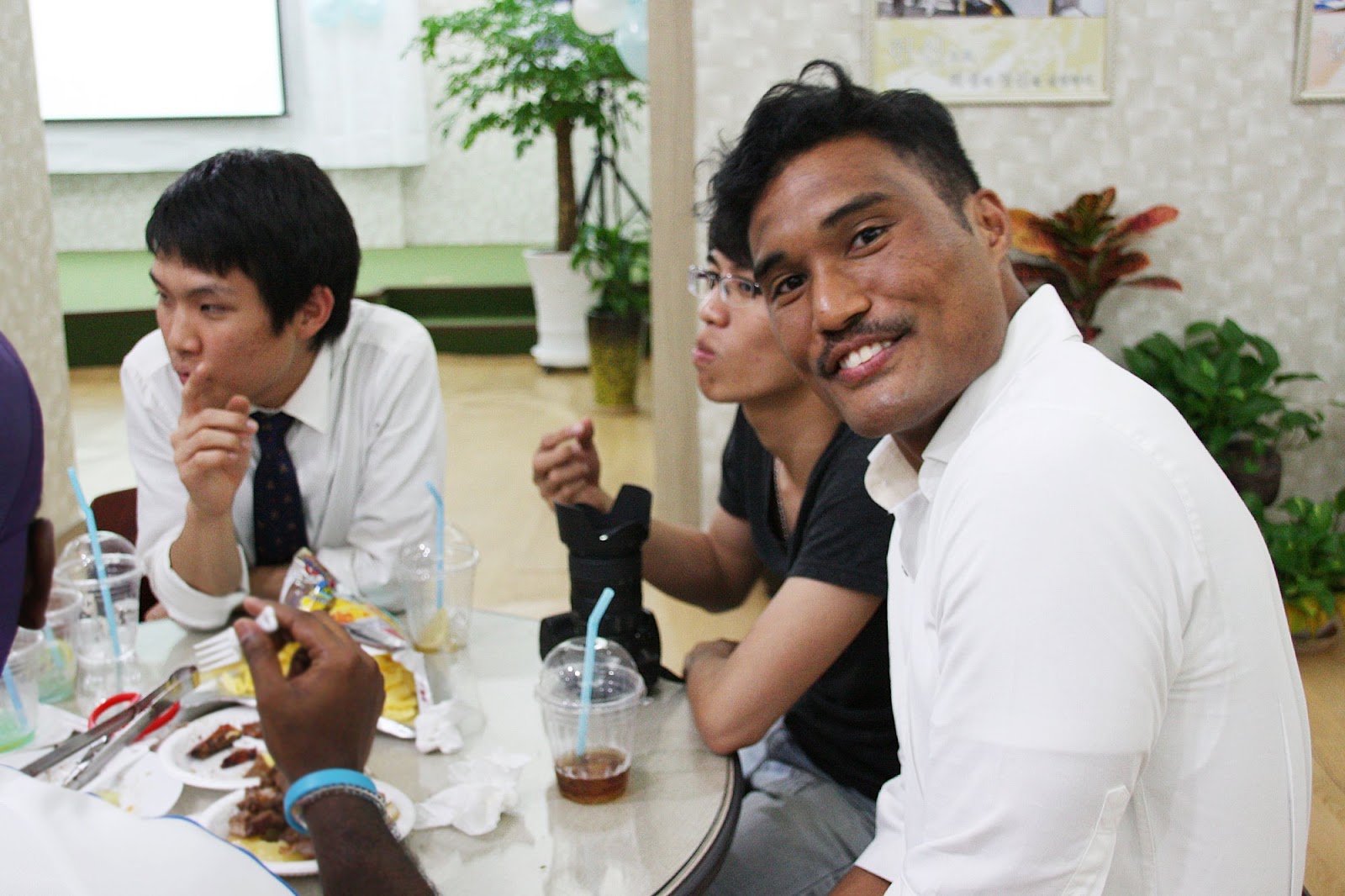
[MANNAM Internationl] We had opened MANNAM Protluck Party

 
Last weekend we had opened protluck party after we moved to our new MANNAM office.
Many MANNAM Volunteer members attended this party.
We were able to try many other countries traditional food through this potluck party.
As enjoying the party, we talked about our country and how foreigners are doing in Korea and the most thing I enjoyed was eating each traditional foods.
One of our members 'Kevin' wrote his feelings that day.


     My name is Kevin and I’ve been a member of MANNAM International since March of this year.  I was looking for a volunteer group that was involved with the local communities around Busan.  After a Google search and a link from KoreaBridge, I found MANNAM and, ever since my first activity with the organization, I’ve made friends with a great group of individuals who all share, despite their various ages, ethnic and educational backgrounds, the same spirit of love and generosity. 

     It was really nice to see the new and familiar faces when I attended the opening party of MANNAM’s Gwangan office this past August 10.  Like all of their volunteer activities, this housewarming/potluck “meet, greet and eat” event was organized yet relaxed.  I met up with Tae-kyu, who showed me the way to MANNAM’s building.  It was only more smiles and hellos when I arrived.  I played catch-up with a few members and had fun chatting with people I had not met before, while enjoying a glass of homemade blue lemonade and a plate of Filipino-style noodles, BBQ beef, crepes and an assortment of table appetizers.  The Korean members of MANNAM did an excellent job in catering to everyone invited.  Some members served the drinks while other members prepared the food and snacks. 

About half an hour into the evening, Ben introduced the group, its mission and members who are in charge of specific activities within the organization.  After introductions, the eating and chatting re-commenced.  I floated around, chatting with guests and members before settling in with the photography group for the rest of the evening. 


     Before the short night was over, we had the obligatory group picture, then cleanup.  Even though everyone was a bit tired, the teamwork didn’t stop as the Korean members along with a handful of the foreign members helped each other rearrange the main hall.  Even though MANNAM has become a bit bigger now, there’s plenty of room for growth.  I look forward to seeing what the group has planned in the future for its members and at its new office space.

이심전심 in MANNAM International

In Korea, like the proverbs, Koreans use four-character idioms a lot.
Today, I will introduce one to you
Before that, four character idiom is called 사자성어.
Each character represents meaning and together, it works like proverbs.
Like the title of the article, today’s four-character idiom is 이심전심.
이 means to write, 심 means mind and 전 means to tell or to communicate.
(two 전 in this idiom represents the same meaning.)
All together, it means, instead of writing or saying it, people can communicate with each other’s mind, understanding without the words.
How can this happen? It might look weird, but I think many of you already have experienced this.
Between friends or families, even they don’t say something, by just looking at each other or just know how they feel and what they want.
Also, among the people who look for the same things, because they have the same goal that they are heading to that they know what they need to each other.
One example for this is MANNAM International.
Even though we have different nationalities, religions and gender, when we work together, we know what to do, what we need and what we can do.
Which is sharing love and achieve WORLD PEACE.
Not only between MANNAM members, through volunteering, we learn to understand others


* Korean four-character idiom
-이심전심(i-sim-jeon-sim) : Instead of writing or saying it, people can communicate with each others mind, understanding without the words.