8/26/2013

[MANNAM Korean Culture] Korean Folk Tales - Two Brothers

In times gone by there lived two brothtrs whose loving ways were the talk of the valley where they lived. They took care of their widowed mother and upon her death they divided everything evenly.
Together they worked diligently from sunup to sundown to produce the most they could from their fields. It never failed that come autumn they had the largest harvest in the valley.
One late autumn evening, after they had spent the afternoon sacking and dividing the last of the rice harvest, the older brother thought, "Brother has lots of expenses since he just got married a few months ago. I think l wiIl put a sack of rice in his storehouse and not tell him. I'm sure he would never accept it if I offered it to him." So, late that night, he carried it to his brother's storeroom.
 The next day, while tidying up his own storage, the older brother was surprised to find he still had the same number of sacks of rice as he had before taking one to his brother. "That's odd," he said, shaking his head, "I'm sure I took a sack of rice to Brother's house last night." He counted his sacks again. "Well," he said, scratching the back of his head, "I'll just take him another one tonight."
So, late that night. he carried a sack of rice to his brother's house.
The next morning, he was again shocked to find he had the same number of sacks as before. He shook his head over and over and decided he would take his brother another sack that night.
 After a late dinner he loaded the rice and set out for his brother's house. It was a full moon and he could see the path quite clearly. Soon he saw a man carrying something bulky coming down the path.
"Why, Brother!" they both called out at the same time. The two brothers put down their sacks and laughed long and hearty for they both understood the mystery behind their unchanging number of sacks of rice. The younger brother thought his older brother could use the rice because he had a larger family.


8/23/2013

[MANNAM Korean Culture] Korean Street Food

Korean Street Food

 Compared to other developed countries such as Japan, Hong Kong, Thailand, and other Asian countries, Korean street food is more widely exposed. Street food is a spin-off of a snack corner that has been franchised to sell snacks such as rice cake stir fried in spicy sauce (tteokbokki), deep fried fritters (tempura), fish cakes (oden), and Korean sausage (sundae).


Pojangmacha The pojangmacha (street vendor) is one of the best places to grab a quick snack or pass the night away drinking with friends. The types of food they serve can usually be eaten quickly while standing up (although someplaces have cheap chairs or benches) or take with you. They have many types of food on sticks or "finger foods." Other specialize in seafood and are geared more towards people who want to sit and have some drinks as well. Smaller stands can be easily carried or rolled from place. Larger, more elaborate ones have plastic tarps to protect patrons from the rain and cold.

source: http://www.lifeinkorea.com/culture/streetfood/streetfood.cfm?xURL=main


I'd like to try it with MANNAM International members when they get a chance.
I think it is loved by foreigners who eat Korean street food.
Also, it can be cheap and simple.
How about having lunch at that Korean street food right after we finish Korean class?

8/22/2013

[MANNAM Internationl] We had opened MANNAM Protluck Party

 
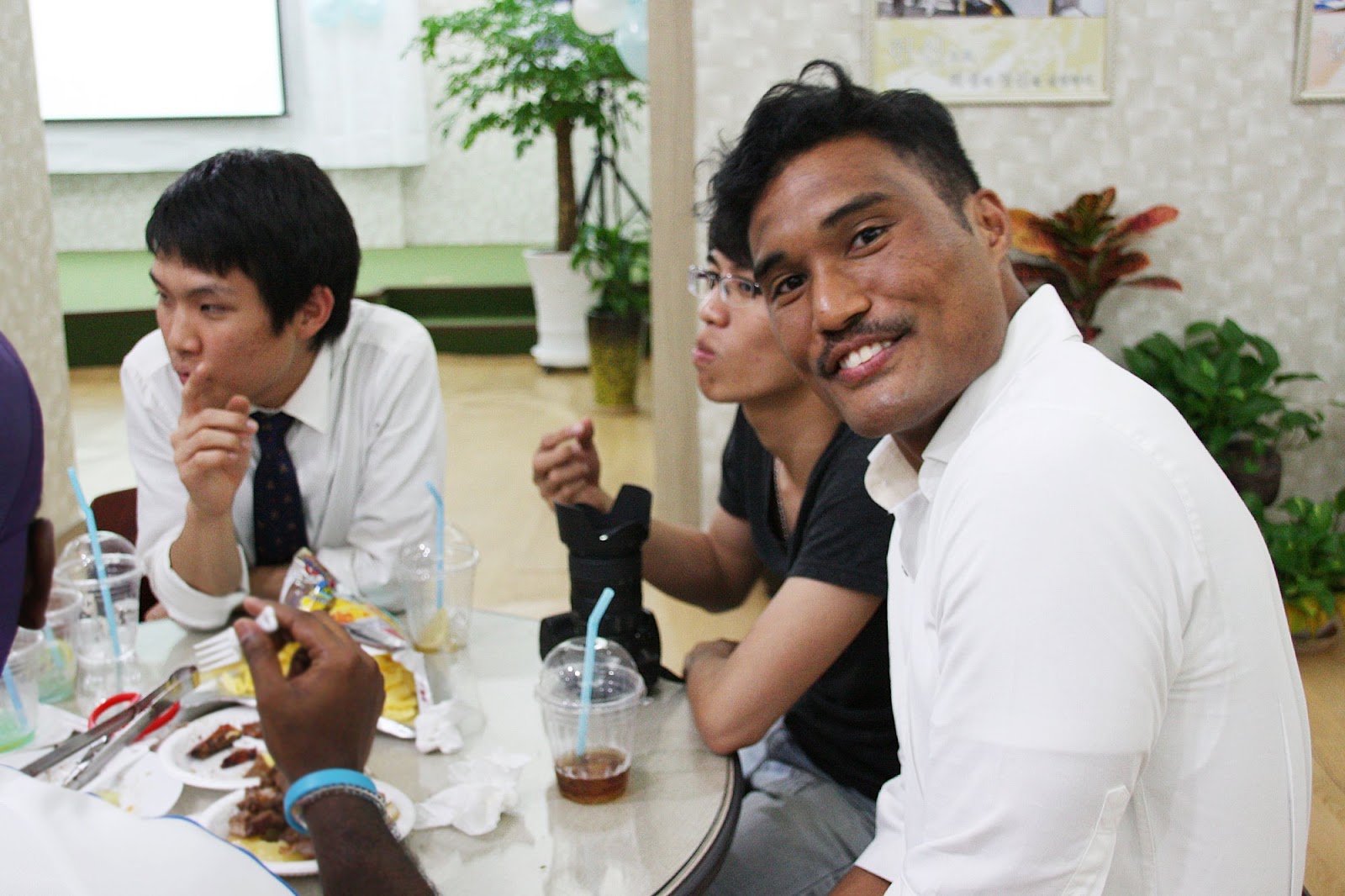
Last weekend we had opened protluck party after we moved to our new MANNAM office.
Many MANNAM Volunteer members attended this party.
We were able to try many other countries traditional food through this potluck party.
As enjoying the party, we talked about our country and how foreigners are doing in Korea and the most thing I enjoyed was eating each traditional foods.
One of our members 'Kevin' wrote his feelings that day.


     My name is Kevin and I’ve been a member of MANNAM International since March of this year.  I was looking for a volunteer group that was involved with the local communities around Busan.  After a Google search and a link from KoreaBridge, I found MANNAM and, ever since my first activity with the organization, I’ve made friends with a great group of individuals who all share, despite their various ages, ethnic and educational backgrounds, the same spirit of love and generosity. 

     It was really nice to see the new and familiar faces when I attended the opening party of MANNAM’s Gwangan office this past August 10.  Like all of their volunteer activities, this housewarming/potluck “meet, greet and eat” event was organized yet relaxed.  I met up with Tae-kyu, who showed me the way to MANNAM’s building.  It was only more smiles and hellos when I arrived.  I played catch-up with a few members and had fun chatting with people I had not met before, while enjoying a glass of homemade blue lemonade and a plate of Filipino-style noodles, BBQ beef, crepes and an assortment of table appetizers.  The Korean members of MANNAM did an excellent job in catering to everyone invited.  Some members served the drinks while other members prepared the food and snacks. 

About half an hour into the evening, Ben introduced the group, its mission and members who are in charge of specific activities within the organization.  After introductions, the eating and chatting re-commenced.  I floated around, chatting with guests and members before settling in with the photography group for the rest of the evening. 


     Before the short night was over, we had the obligatory group picture, then cleanup.  Even though everyone was a bit tired, the teamwork didn’t stop as the Korean members along with a handful of the foreign members helped each other rearrange the main hall.  Even though MANNAM has become a bit bigger now, there’s plenty of room for growth.  I look forward to seeing what the group has planned in the future for its members and at its new office space.

이심전심 in MANNAM International

In Korea, like the proverbs, Koreans use four-character idioms a lot.
Today, I will introduce one to you
Before that, four character idiom is called 사자성어.
Each character represents meaning and together, it works like proverbs.
Like the title of the article, today’s four-character idiom is 이심전심.
이 means to write, 심 means mind and 전 means to tell or to communicate.
(two 전 in this idiom represents the same meaning.)
All together, it means, instead of writing or saying it, people can communicate with each other’s mind, understanding without the words.
How can this happen? It might look weird, but I think many of you already have experienced this.
Between friends or families, even they don’t say something, by just looking at each other or just know how they feel and what they want.
Also, among the people who look for the same things, because they have the same goal that they are heading to that they know what they need to each other.
One example for this is MANNAM International.
Even though we have different nationalities, religions and gender, when we work together, we know what to do, what we need and what we can do.
Which is sharing love and achieve WORLD PEACE.
Not only between MANNAM members, through volunteering, we learn to understand others


* Korean four-character idiom
-이심전심(i-sim-jeon-sim) : Instead of writing or saying it, people can communicate with each others mind, understanding without the words.

7/21/2013

[MANNAM humorous story] Gyun Woo & Jick Nyo – Asian Legend


This story is a particularly special one.
It finds it’s origin in China, but since those ancient days it has been passed down from generation to generation in Korea and Japan. Neighboring countries with a ‘not-so-pleasant’ past, all share in the moral message of this special folk legend.

The story begins like this…
There was once was a great an powerful king in the heavens. He lived in a large palace and ruled over all nations of the heavens. Out of everything this king owned and cared for he had only one true delight, his daughter, Jik Nyo.
Jik Nyo means “woman who weaves cloth” and she was the kings only child. As the years went by she grew in beauty, until one day she became the most beautiful woman in all the kingdom.
The time came when the king knew it was time for Jik Nyo to marry, so he made it his business to find her the most suitable husband, to live, work and inherit the kingdom beside her.
Eventually the king found a young man called Gyun Woo.
 Gyun Woo means a man who herds cattle, and like his names sake, he was a hard worker and a dedicated young man. The king knew that he was a good match for his daughter. With her honest sense of responsibility and respect, and his hard work and dedication they would make each other very happy, while leading the kings nations well.
Jik Nyo and Gyun Woo got married in the palace and spent their first few weeks relaxing and settling into their new lives. They were madly in love.
 The king grew more and more concerned as the couples short “honeymoon phase” of silly fun and playful, young love,  turned into many months of carelessness, love-struck behavior.
 Instead of being responsible, dedicated and hard working the two of them played all day long and did not work at all, often leaving a trail of mess in their wake.
The king became angry. And in his rage decided that the couple needed to be punished and taught a lesson. They had become the worst example and completely careless in their comfort and self-indulgence.
“Everyone else is in the kingdom of heaven is working so hard, but you two are just playing, day in and day out. You have forgotten your duties and grown selfish in your love of one another, forgetting that the rest of the kingdom relies on you.” After saying this, the king announced the Gyun Woo’s punnishment. “You will be seperated from Jik Nyo and live far in the east. Jick Nyo, you must go and live in the west.”
He ordered them to live apart, despite their marriage and love for one another. Perhaps living a life so far from the one you love, would remind them of their respectful duties to their kingdom and their king.
Jick Nyo cried bitterly, she begged her father to reconsider his decision, but the king did not change his mind and they did as they were told, destined to live seperate lives forever.
 There was one condition to their punishment, the king’s one small mercy, and that was they were allowed to meet each other only once a year.
“Go to the Milky Way river on the seventh day in July” the king said, “and there you will be able to meet, only one time per year.”
Gyun Woo and Jick Nyo lived in sadness. They loved each other so much and each day apart felt like their hearts were breaking. After what felt like a thousand years, finally the seventh day in July arrived. Both Gyun Woo and Jick Nyo hurried to the Milky Way, they were eager to see each other again and the anticipation was great. They called out from opposite side of the Milky Way, shouting each others names repeatedly, but they could not see one another, the distance was too far from one bank to the other.
They longed to speak, and tell one another how much they loved, missed and cherrished each other, but nothing could be done… there was no way to reach across the vast expanse between them.

Their tears fell in the Milky Way and poured down on the earth like a flood. The more their saddness grew and their tears fell, the stormier the weather became on the earth. Soon the birds of the air saw that they were in grave danger. If something didn’t happen to sooth the couples sorrow the earth would be washed away in their tears.
 All of the birds worrying lead them to conjure up a solution for the two lovers to meet.
“We need to make a bridge that will stretch across the Milky Way”, they said.
“But it is so high up…” a little Sparrow said.
“Then we need the help of the Crows and the Jays, they have strong sturdy wings and can fly higher than the clouds, up to the Milky Way”, said the wise old Pigeon.
The Crows and Jays agreed to help, and all that was left to do now was to wait, for the seventh day in July, and hope that it came before JKik Nyo and Gyun Woo’s hearts grew more weary.
One year passed again, and it became July seventh. All the Crows and the Jays in the world gathered and together, they flew high up to the Milky Way where they lined up across the river, creating a soft bridge that floated across the great divide.

 
At last Gyun Woo and Jick Nyo walked to meet each other, and their tears ceased as they professed their undying love.
From that day forth, every year, on the seventh day of July, Crows and Jays all over the world built a bridge across the Milky Way, and the earth was safe from floods.
 This bridge was called Ojack-kyo – a bridge built by Crows and Jays.

source: http://mannamimpact.wordpress.com/category/word-of-mouth-cultural-myths/

7/17/2013

[MANNAM humorous story] The Disobedient Frog – Korean Myth


There was once a very naughty little frog who lived in a big pond with his mother. Out of all the animals, this frog was by far the biggest trouble-maker, never listening to anyone, and always embarrassing his mum in front of the others.
 The little frog was stubborn and refused to obey his mothers requests, always choosing to do the exact opposite of whatever she told him. He never felt bad for the grief that he gave her and his poor mother was so worried about her son.
“Whatever shall become of my boy if he continues to be so disobedient?” she thought to herself. “What shall I do with him? How can I  do to straighten him out and help him break his awful habits?”
The mother frog felt greatly burdened by the fact that her son had no respect or kindness in his heart, while her little  son just laughed and teased his mother for all her worry and concerns.
“Don’t be ridiculous!”, he said, “I am perfectly fine, just the way I am now, mum.”
The mother replied: “Oh, is that so?…Then why is it that you cannot even croak properly?” she asked, knowing full well that he was still young and need someone to teach him. “You don’t even sound like a frog, my son. Here, let me teach you how it is done.” With a smile, she puffed herself up and let out a loud croak
“Kaegul Kaegul! Now you try…” she said.
The Little Frog smugly puffed himself up and with all his might let out a loud “Kulgae! Kulgae!”

As always he was doing exactly the opposite to what his mother asked of him.
“Why you little rascal, you listen to me… if you know what’s good for you you would…”
 “Kulgae! Kulgae!” croaked the little frog while he hopped away, completely ignoring his mothers reprimands.
Eventually, after years of worrying and stress from her disobedient son, the mother frog became very ill. The daily scolding and constant defiance from him was taking it’s toll, yet still, he continued to misbehave.
 One day she called him to her bedside. “My son,” she said, “I don’t think
 I will live much longer. When I die, please bury me next to the stream, not on the mountain”
She asked him to do this, knowing that he would undoubtably to the exact opposite of whatever she asked of him, just like he had all his life.
Only a few days after she asked him that one last favor, mother frog passed away. The little frog wept bitterly and was very upset that his mother was gone. He blamed himself for her illness, and knew that it was because he worried her so much with his disobedience that she became so sick. “Why didn’t I listen to her?” he scolded
 himself.”Now she’s gone, and it’s all my fault”.
The little frog thought about his mother and all the trouble he had caused her. Finally he decided that because he had always been so naughty, he was now truly sorry… he would honor his mother by listening to her one last wish.
“This time I will do exactly what she told me to do”, he thought to himself.
 So went and buried his mother next to the stream, even though he thought that it was not a very good idea.
A few weeks later there was a heavy storm, with plenty of rainfall and the little frog was concerned that his mothers grave would be washed away. The stream could easily overflow and that would mean that his mothers grave was not safe. He could not sleep, and decided to go to the streams banks to keep watch and make sure her grave was unharmed.
 In the pouring rain he sat, crying over and over again,
“Kaegul! Kaegul! Please don’t wash my mother away!”
Every single time it rained the little frog went and kept watch, and since then all  green frogs have cried,
“Kaegul! Kaegul!” when it rains.

6/22/2013

[MANNAM Basic Korean Class] Learning Grammar pattern (1)

Grammar 1 -으세요 : sentence ending for the honorific form- present
⦁'-으세요‘ is used with verbs and adjectives. If the verb/adjective stem ends in a consonant, '-으세요’ is added, If the verb/adjective stem ends in a vowel, '-세요‘ is added.
[동사verb] 읽다(to read) : 읽 -으세요 → 읽으세요
가다(to go) : 가 - 세요 → 가세요
[형용사adjective] 친절하다(to be kind) : 친절하 -세요 → 친절하세요
e.g. ① 선생님이 여섯 시에 집에 가세요. (The teacher goes home at 6 o'clock).
② 우리 어머니가 책을 읽으세요. (My mother is reading a book).
③ 우리 아버지가 정말 친절하세요. (My father is really kind).
'-으세요‘ is also used to make a polite question.
e.g. 마이클 씨, 지금 학교에 가세요? (Michael, are you going to school now?)
마이클 씨 어머니가 선생님이세요? (Is Michael's mother a teacher?)
 
Some verbs have special honorific forms.
Irregular Verbs/adjectives

1. 'ㄷ‘ irregular verbs
with verbs that end in the consonant 'ㄷ‘, the 'ㄷ’ of the stem is changed to ‘f' and then '-으세요’ is added.
듣다: 듣  -으세요  → 들으세요
e.g. 우리 어머니가 음악을 들으세요. (My mother is listening to music).
2. 'ㅂ‘ irregular adjectives
with adjectives that end in the consonant 'ㅂ‘, the 'ㅂ’ of the stem is changed to '우‘ and then '-으세요’ is added.
춥다: 춥 -으세요 → 추우 -세요  →  추우세요.
3. ‘ㄹ’ irregular verbs
with verbs that end in the consonant 'ㄹ‘, the 'ㄹ’ of the stem is dropped and then ' -으세요‘ is added. The conjugated honorific forms of 살다(to live) and 사다(to buy) are spelled the same way. You can tell which word it is from context.
살다: 살 -으세요  → 사 -세요  → 사세요
e.g. 선생님은 서울에서 사세요. (The teacher lives in Seoul.)
     선생님은 커피를 사세요. (The teacher buys coffee.)
⦁The honorific '계세요‘is used only when the subject(of the sentence) is a person, and when the verb '있어요’ has the meaning of location or existence of the person.
e.g. ① 우리 할머니가 방에 계세요. (My grandmother is in the room).
                ↳ The subject is a person.
⦁When the subject is a thing (not a person) and the verb '있어요‘ has the meaning of possession, '있으세요/없으세요’ is used to express respect for the possessors of the thing.
e.g. ① 오늘 오후에 시간이 있으세요? (Do you have time in the afternoon?)
                     ↳ The subject is a thing.
    ② 우리 할머니는 핸드폰이 없으세요. ( My grandmother doesn't have a cellphone).
                        ↳ The subject is a thing.
 
Note
When creating the honorific form, the subject marker can be changed from '이/가‘ to '-께서’ to make the statement even more polite.
어머니가 → 어머니께서
e.g. 우리 어머니께서 오후에 시장에 가세요. (My mother goes to market in the afternoon).